The education sector has seen massive digital changes over the past ten years. Right from e-learning classes and online exams to virtual parent-teacher meetings, schools and colleges are increasingly adopting technology to manage their activities in a streamlined manner.
At the beginning of this shift is the concept of ERP in educational institutions.
An automated ERP software for education assists educational institutions in managing their academic and administrative activities in a more efficient manner. But what are the benefits of implementing ERP in schools and colleges?
In this blog, we will discuss the major benefits of ERP in education and why it is an intelligent decision to opt for a smart ERP solution.
So, let’s start.
Understanding ERP in Educational Institutions
ERP stands for Enterprise Resource Planning. And in educational institutions, it is a digital platform that combines all the processes of an institution into one system.
The processes that it manages include:
- Admissions
- Student records
- Attendance
- Fee collection
- Examination management
- HR and payroll
- Timetable scheduling
- Library and inventory
- Communication portals
With this schools or institutes will be able to manage all its processes through one platform instead of managing different systems.
Why Educational Institutions Need ERP Software
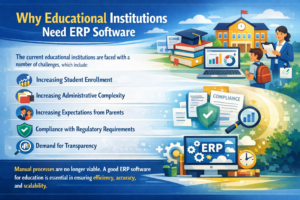
The current educational institutions are faced with a number of challenges, which include:
- Increasing student enrollment
- Increasing administrative complexity
- Increasing expectations from parents
- Compliance with regulatory requirements
- Demand for transparency
Manual processes are no longer viable. A good erp software for education is essential in ensuring efficiency, accuracy, and scalability.
Let’s discuss the key advantages of ERP in education in detail.
-
Centralized data management
One of the major advantages of ERP in an educational institution is that data is stored centrally. All the information is stored in one secure database. This ensures that:
- There is no duplication of data
- It is easy to access information
- Reports are generated quickly
- Data accuracy is improved
Administrators do not have to rummage through files and spreadsheets. All information is at their fingertips with the click of a mouse.
-
Simplified administrative tasks
Administration sections of an institution are involved in a variety of repetitive tasks on a daily basis. These include:
- Attendance management
- Fee collection
- Record management
- Document verification
All these tasks are automated with the use of erp software in education.
Automation assists in:
- Reducing paperwork
- Eliminating errors
- Conserving time
- Boosting productivity
This is one of the greatest advantages of ERP in education.
-
Improved communication between stakeholders
Communication is the key to the success of organizations. A good ERP system should have the following features:
- Parent portals
- Student portals
- Communication tools for teachers
- SMS and email notifications
With the use of ERP in schools, institutions can now send instant notifications to parents regarding attendance, exam dates, and more.
-
Efficient admission management
Manual admission management can be a daunting task. An erp software for education can manage the entire admission process.
The features of the software include:
- Online application forms
- Eligibility checks
- Merit list preparation
- Document verification status tracking
These features make the admission process smooth and easy for the schools.
-
Better financial management
Financial transactions are essential for any educational organization. ERP solutions assist in handling:
- Collection of fees
- Online transactions
- Tracking of expenses
- Budgeting
- Financial reporting
Financial accessibility is one of the most important advantages of using ERP solutions in educational institutions. Automated fee reminders eliminate delays, and real-time reporting enables management to take informed actions.
-
Improved academic management
Academic management demands accuracy and coordination. Using ERP in educational institutions, the management can:
- Develop and manage timetables
- Monitor attendance
- Administer online exams
- Prepare report cards
- Academic performance tracking
Teachers find it easy to grade students and maintain records. Students can view assignments, performance, and progress reports from specific portals.
-
Data-driven decision-making
Contemporary institutions make use of data analytics for better results. An effective ERP software solution for the education sector enables administrators to:
- Analyze student performance trends
- Detect dropout risks
- Evaluate teacher performance
- Admission trends
These enable informed decision-making and expansion of the institution.
-
Enhanced data security
Institutions of learning deal with confidential data like student information, financial information, and employee information. A good ERP system provides:
- Role-based access control
- Data encryption
- Cloud hosting with enhanced security
- Data backups
Data security is an integral part of ERP in institutions of learning, ensuring adherence to data security regulations.
-
Scalability for growing institutions
As institutions grow and change, their requirements become more complex. A flexible ERP software solution for the education sector enables institutions to:
- Integrate new modules
- Support multiple branches
- Increase student enrollment
- Enhance administrative capabilities
Scalability helps institutions remain sustainable in the long run without regular changes in the system.
-
Reduced operational costs
Though ERP installation involves initial costs, it helps institutions save operational costs in the long run. Operational cost savings are achieved through:
- Less paperwork
- Lower printing costs
- Less administrative burden
- Fewer manual errors
The primary benefit of using ERP in the education sector is increased efficiency with lower operational costs.
-
Enhanced transparency and accountability
Transparency is becoming increasingly important in the education sector. With the use of ERP in educational institutions, the following activities can be tracked by the management:
- Attendance records
- Fee payments
- Performance
- Staff activities
-
Better parent engagement
Parents in today’s world demand updates on their child’s performance on a real-time basis. ERP systems provide the following:
- Attendance notifications
- Performance tracking
- Homework updates
- Fee payment notifications
This level of engagement is a huge competitive advantage for institutions that use erp software for education.
Why Institutions Are Choosing Cadence for ERP Solutions
Choosing the right ERP software is as crucial as choosing to implement ERP. Cadence offers future-ready ERP software for education to schools and colleges.
We offer the following benefits to institutions:
- Fully integrated academic and administrative systems
- Easy-to-use interfaces
- Cloud flexibility
- Enhanced reporting capabilities
- Robust data security
- Customizable processes
As a trustworthy ERP solution provider for the education sector, Cadence assists schools in automating processes, improving communication, and increasing efficiency.
For institutions seeking to unlock the full potential of ERP in education, Cadence offers reliability, innovation, and hassle-free implementation assistance.
Future of ERP in Educational Institutions
The digital shift in the education sector is gaining popularity by increasing hybrid learning and AI insights are becoming common practices.
The use of ERP in educational institutions is also expected to increase, incorporating new technologies that improve learning and management practices.
Institutions that use ERP first will have an edge over others due to efficiency, transparency, and innovation.
To wrap up
The education sector is undergoing a radical transformation, and it is necessary for institutions to keep pace with the times to remain competitive. The implementation of ERP software in the education sector is no longer a choice but a necessity.
Right from managing data and finances to enhanced communication and monitoring of academic performance, the list of benefits of using ERP in the education sector is endless.
By adopting ERP in educational institutions, schools and colleges can optimize their processes, engage stakeholders effectively, and lay a solid foundation for future success.
By partnering with a reliable and trustworthy ally such as Cadence, schools can look forward to a brighter, more efficient, and more empowered future.